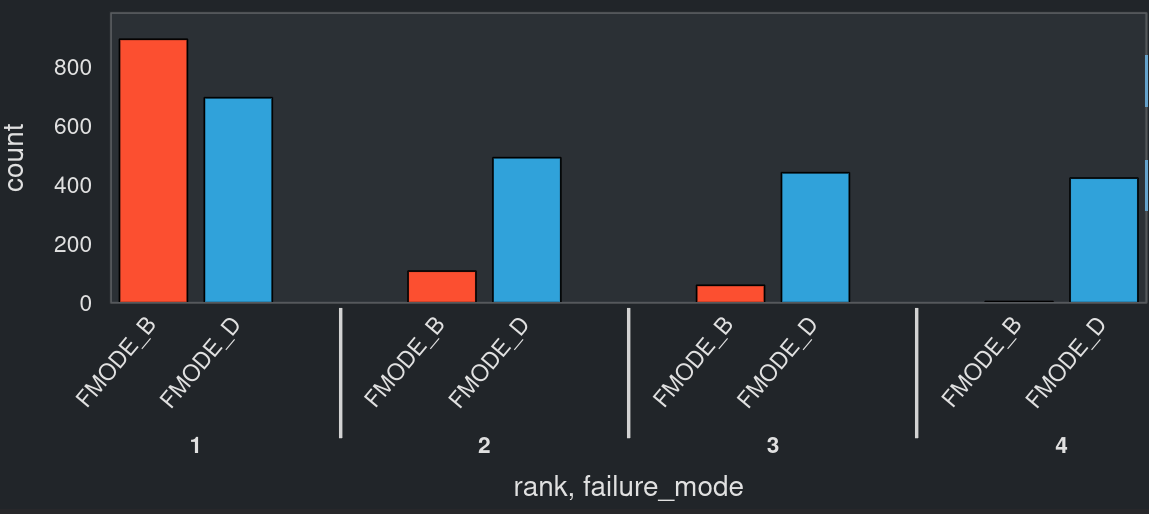
The Problem Quality control and testing actions are always mandatory before delivering a product or a service. In this particular case study, we are considering a some manufacturing data recording during testing. Every row is the result of a testing procedure. The tabular data may look like this timestamp id result retests 13:32:10 #AA3 pass 1 13:32:20 #AA4 failmode1 1 13:32:30 #AA5 pass 1 13:32:50 #AA4 failmode1 2 13:33:20 #AA4 pass 3 From this tabular data, we may look how much of units passed on first try, how much units failed with mode 2 on first, second, … tries etc… When a unit fails some $K$ times, it is scrapped. In our demo, we take $K$ to be 4. Different failure modes depend on a various number of factors. We may divide this into two main “categories” - the testing procedure or the intrinsic problem of the unit. ...
Finding modes in multimodal distribution with Silverman
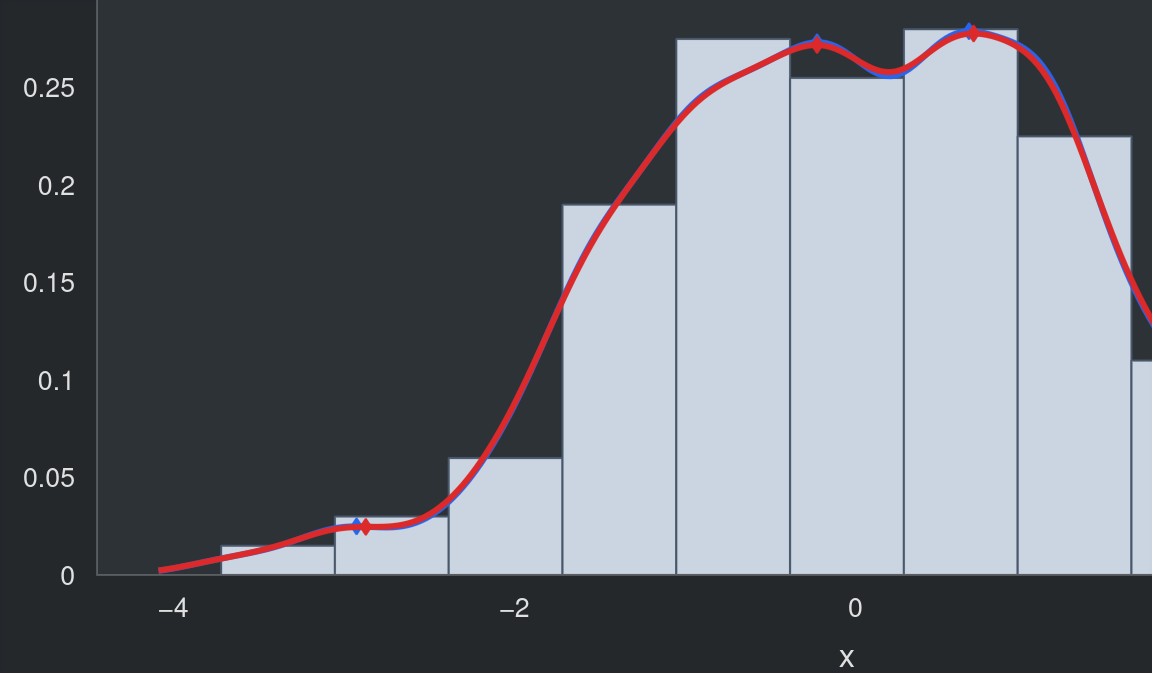
The Problem Consider an industrial set of measurements, like a parameter from a batch of products. If we assume that the realisations of our measured random variable are IID, we expect that the resulting distribution is gaussian. However, if the underlying process has genuinely multiple sources, the resulting distribution will be a mixture of gaussians, or a mixture of other distributions. Such process may occur if the there is a significant difference in the originating raw material batches. This is the reason, why it is important to be able to identify a potential bi/multi-modality in the observed distribution. Arguably, the best method would be to visually inspect all of the distributions, which is sometimes not possible. A visual inspection can be replaced by a shape recognition algorithm or similar. The resources to run such an algorithm may be limited or unavailable due to other reasons. This is why one may want to rely on “older”/classical methods such as the usual hypothesis tests. ...
Gauge R&R - ANOVA & Multilevel models in python
The Problem Consider the following known industrial problem - we manufacture samples (possibly with different dimensions, characteristics, etc…) which we are then testing/verifying. What we want then is to characterize the measurement processes, as it may have multiple sources of variability. Indeed, the measurement process can depend on the operator and appraisal (i.e. testing machine), the part itself and potentially some other things that we include in our observations. Additionally to the mentioned single factors, interactions could also be significant (e.g. some tester or operator is better off with some particular type of the part). ...
Applications of group representation theory
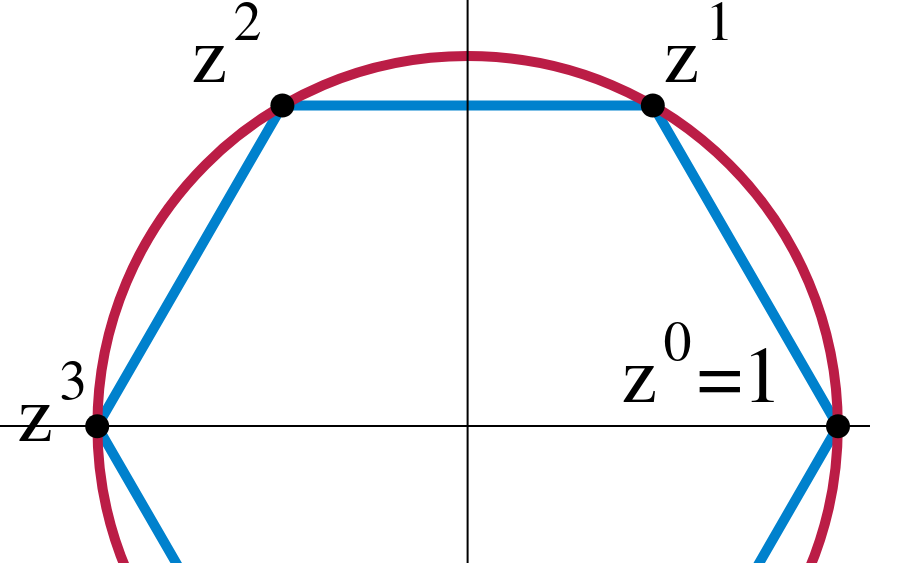
What is a group? A group is a very abstract mathematical concept that I like to thing of as an extension to the notion of a set. That is, a set is quite an abstract mathematical concept. A set is an object that “groups” any elements by its properties, or even using any “logic” we can think of. One can define a set to be, for example, all people of age 32. Mathematically, one can define a set of all real numbers, a set of all even numbers, a set of even functions, etc… A set can be finite, countably infinite, uncountably infinite, etc… A set can be caracterized by different things, for example the cardinality of the set. The cardinality can be thought of as the size of the set. ...
Cuda Notes
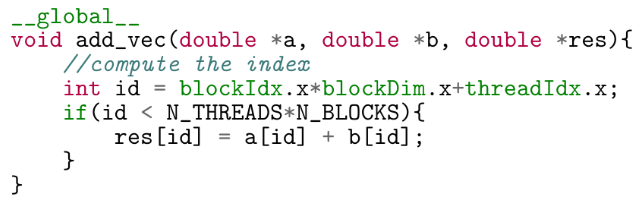
GPGPU programming is quite a promising field, involved in different applications. In majority, they are more science related, such as, linear algebra (matrix and tensor operations). Many of these packages are already successfully implemented in ready-to-use libraries. I started to study GPGPU programming on my own. And due to the fact that, in my opinion, the CUDA programming is poorly documented (i.e. videos, tutorials, books), I decided then to write my personal notes on this topic. These notes include in fact a significant number of information from different sources, such as books, online tutorials, NVidia’s official documentation and blogs. ...